


A Smart Road-Safety Solution for Accident Prevention
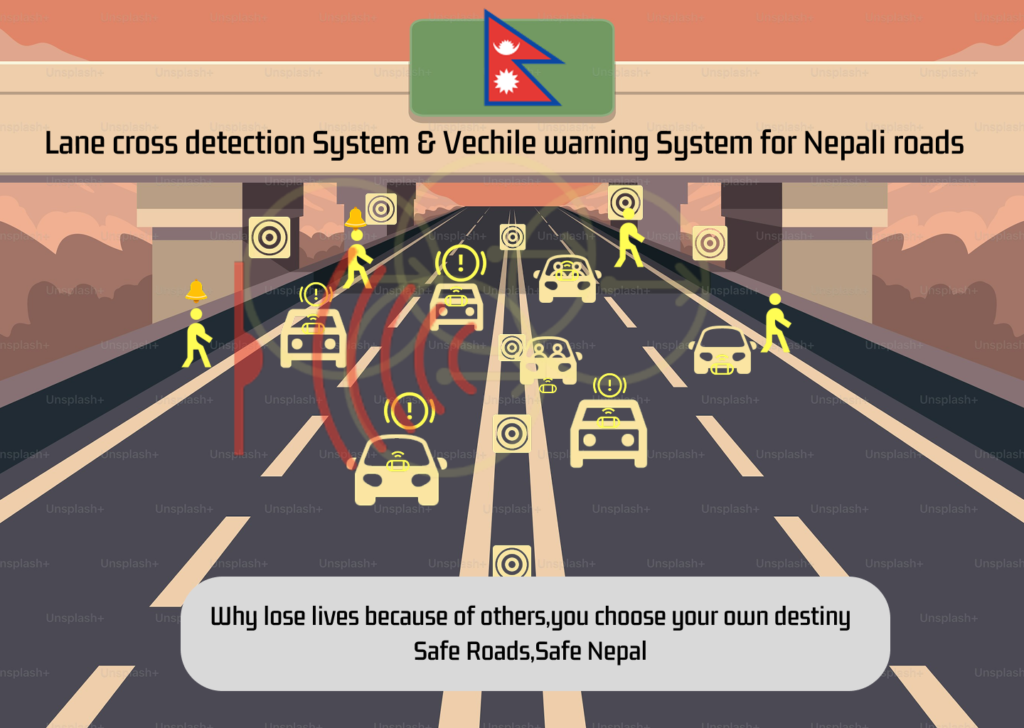
Nepal’s road conditions—narrow highways, blind turns, steep hillsides, and unpredictable driving patterns—make lane-crossing one of the biggest causes of accidents. To help reduce these risks, we propose a Lane Cross Detection & Vehicle Warning System, a smart, sensor-based safety solution designed specifically for Nepali roads.
🔍 What is the Lane Cross Detection System?
It is a road-safety technology where sensors are installed along the center line of highways. Every vehicle can install a small embedded device that receives instant alerts whenever another vehicle crosses the lane dangerously.
This system provides real-time warnings, helping drivers along with the pedestrians to avoid head-on collisions and react faster.
🛣 Why Nepal Needs This System
Nepali highways face challenges such as:
- Blind corners & sharp bends
- Narrow roads with no dividers
- High risk of head-on collisions
- Poor visibility in hills and fog
- Increasing number of fast vehicles
A reliable early-warning system can significantly reduce critical accidents caused by lane violations.
⚙️ How the System Works
1. Smart Road Sensors
Sensors placed along the center line detect:
- Vehicles crossing into the opposite lane
- Direction of movement
- Speed (optional upgrade)
These sensors operate on low-power technology and can be solar-powered, making them ideal for remote and rural areas.
2. In-Vehicle Device
Each vehicle can install a compact, affordable embedded device that:
- Receives warnings from roadside sensors
- Alerts the driver through sound + visual signals
- Works without mobile data or internet
3. Long-Range Communication
The system uses long-range radio communication (LoRa), which allows:
- 1–10 km wireless range
- No dependency on mobile networks
- Reliable operation in hills and tunnels
This ensures vehicles always get warnings even in regions with no network coverage.
🔔 Real-Time Warning System
When a vehicle crosses the center line:
- Sensors detect the violation
- Nearby vehicles along with pedestrians receive instant sound alerts
- Drivers get enough time to slow down or steer safely, pedestrians get more time to react
This can prevent countless head-on collisions, especially on highways and hilly roads.
💰 Affordable & Practical for Nepal
The system is designed to be:
- Low cost to install
- Low maintenance
- Suitable for rural highways
- Scalable across districts
Municipalities, traffic police, and road authorities can deploy this in accident-prone zones.
📦 Subscription Model for Vehicles
To keep the system sustainable, vehicles can subscribe to the safety device:
One-time installation fee: Rs. 500 – 1,000
Monthly service fee: Rs. 50 – 100
This ensures continuous service, updates, and maintenance of roadside sensors.
🏛 Ideal for Government & Municipalities
This system can be implemented in:
- Highways with frequent accidents
- Blind corners on hilly roads
- School zones
- Narrow bridges
- Busy city roads
Government agencies can adopt it as part of Nepal’s smart road-safety initiative.
🌍 Benefits of the System
- Reduces head-on collisions
- Protects drivers from sudden lane-crossers
- Works even without mobile networks
- Improves road discipline
- Supports smart-transport development
- Saves lives on dangerous routes
📢 Conclusion
The Lane Cross Detection & Vehicle Warning System aims to bring modern technology to Nepali roads, making driving safer for everyone. With affordable components, long-range communication, and real-time alerts, this solution can prevent thousands of accidents and set the foundation for a smarter, safer Nepal.
If you’re interested in collaboration, pilot testing, or implementing this system in your area, feel free to contact us.